AI systems are starting to plan, choose, delegate, verify, and adapt across long-running workflows. In other words, they’re becoming agentic.
That shift raises new architectural questions for AI PMs. How do agentic designs differ from other AI architectures? How do we design software made of multiple autonomous or semi-autonomous agents? How do they coordinate, reason, take action, and recover from failure?
The answers to these questions will define how tomorrow’s AI products actually work: inside companies, inside products, and inside PM workflows. Understanding the underlying agentic architecture is quickly becoming table stakes for AI Product Managers who want to make good decisions about capability, safety, and roadmap.
AI for Product Managers Certification
Adopt an AI-first mindset: design AI-native UX, build agents, define modern PRDs, and ship trustworthy AI-powered products.
What Is Agentic Architecture?
Agentic architecture is the design framework that enables AI agents (autonomous or semi‑autonomous programs) to work together toward complex goals. It shapes the virtual workspace and workflows so that AI models can be orchestrated into intelligent, goal‑driven systems.
In practice, an agentic architecture provides the rules, memory, and data connections that let agents perceive their environment, plan actions, and collaborate with each other (and with humans).
Unlike traditional AI pipelines, which execute fixed tasks on static data, agentic architectures support dynamic reasoning. Deployed AI agents can access context, call tools or APIs, and adjust plans on the fly. In short, for AI-native teams, agentic architecture turns AI from a one‑off responder into a goal-oriented operator in an intelligent ecosystem.
As Karandeep Anand (President and CPO at Brex) said on the Product Podcast:
The day a finance team trusts an AI to handle their money is when AI has truly delivered. You can build self-driving cars and cool agents, but try convincing finance people to trust an AI with their money. That’s the real test for the AI agent you’re deploying.
Why Agentic Architecture Matters
Agentic architecture matters because it lets AI systems move beyond single, static tasks and operate as coordinated, goal-driven teams that can plan, act, and adapt in real time. This enables software to automate entire workflows end-to-end, learn from outcomes, and deliver higher-value results with less human micromanagement.
Agentic architecture creates a context-aware ecosystem where knowledge flows freely: agents access the right data and each other’s insights in real time, continuously learning from new events. Over time, the system builds collective memory and becomes smarter across the organization.
This shift matters for product teams and businesses for several reasons:
Faster, smarter decisions. Agents can interpret intent and act in context with human-in-the-loop embedded only at the crucial parts.
End-to-end workflow automation. You can automate whole processes, not just single tasks, so the system actually gets work done.
Continuous learning and improvement. Each interaction teaches the system something, so quality and efficiency compound over time.
Resilience and modularity. Specialized agents isolate failures and let you swap or upgrade pieces without breaking everything.
Scalability and flexibility. It is easier to add new agents, tasks, or data sources than to keep rewriting monolithic workflows.
Alignment and governance. You can encode goals, policies, and guardrails so autonomous behavior still fits business intent and risk limits.
Core Principles of Agentic AI System Architecture
Agentic architectures are guided by a few key principles that ensure agents are both powerful and safe. These principles, drawn from expert analyses, form the “building blocks” of any agentic system:
1. Autonomy with guardrails
AI agents need enough freedom to make decisions and take actions on their own, but never so much that they can create chaos.
In practice, you define exactly what each agent is allowed to do, which systems it can touch, and when it must hand off to a human or another agent. A customer support agent, for example, might resolve low-risk tickets autonomously but must escalate anything that touches refunds above a threshold, compliance, or legal risk.
2. Goal-directed behavior
Every agent in a multi-agent system should be able to answer a simple question: What goal am I working toward right now?
Agentic architecture makes this explicit by tying agents to clear product OKRs, from business outcomes at the top to concrete tasks at the bottom. That way, agents do not just execute prompts; they understand how their work connects to revenue, cost, risk, or product experience and can prioritize accordingly.
3. Context awareness and environment perception
Agents are only as smart as the context they can see. An agentic architecture gives them structured access to state, memory, and knowledge so they can recall past interactions, see current conditions, and use the right data in each decision.
The result is behavior that feels informed and consistent. For example, an underwriting agent who knows a customer’s history instead of treating every application like a blank slate.
4. Orchestrated collaboration
Most useful systems involve more than one agent, which means collaboration is a first-class design problem. The architecture needs a way to coordinate task handoffs, avoid duplicate work, and resolve conflicts so agents behave like a cohesive team.
Often this means introducing an AI agent orchestration patterns or service that decomposes goals, routes work to the right specialists, and stitches the final outcome together.
5. Continuous learning and adaptation
Agentic systems should get better the more they are used. That requires feedback loops that capture outcomes, evaluate whether agents achieved their goals, and feed those insights back into prompts, policies, or even model selection.
Over time, the architecture supports a kind of operational memory, so workflows become faster, safer, and more accurate without needing a full redesign every time something changes.
Agentic Architecture vs. Orchestration Patterns
A common confusion is the difference between agentic architecture and agent orchestration. Orchestration is part of an agentic architecture. Architecture is the entire blueprint (data layers, governance, models, interfaces), whereas orchestration refers specifically to how AI agents are coordinated within that system.
Think of it this way. Agents are the actors doing work (e.g., an AI that writes code, another that searches data). Agent orchestration is like the playbook that tells those actors what to do and when. Agentic architecture is the whole environment. This includes the offices, libraries, rules, communication channels, and governance policies that support the agents and orchestrators.
In practice, agent orchestration covers patterns like how one agent passes data to another, when tasks are parallelized, and how failures are handled.
One way to differentiate them is to consider the roles.
In an agentic architecture, there is often an orchestrator agent. It’s the “manager” of the other agents.
This agentic orchestrator takes a big objective (e.g., “prepare a quarterly report”) and splits it into sub‑tasks, assigns them to specialized agents, and then aggregates the results.
Orchestration patterns are essentially the strategies that such an orchestrator uses (vertical in-app orchestration, horizontal cross-app orchestration, event-driven flows, etc.). But architecturally, you still need a design that provides the orchestrator with context (memory, knowledge), interfaces to the agents, and oversight mechanisms.
Treat agent architecture and orchestration distinctly
For most AI-native product teams, it makes sense to design an agentic layer first and only then “staffing it with the right agents” to execute tasks. In other words, architect the system of agents and rules. Only then plug in the task‑oriented agents.
The agents (tools) handle workloads, but the agentic architecture (the system) ensures the outcome is correct, safe, and aligned with business goals. This distinction helps product teams avoid the trap of focusing only on flashy agents while neglecting the governance and glue that make them reliable.
Another perspective is from a recent enterprise report. It points out that modern architectures are evolving so that execution of tasks is separate from workflow orchestration. That aligns with the idea above: the agentic architecture layers ensure that task execution by agents is decoupled from the logic of coordination and policy.
By separating these concerns, companies can manage many agents at scale, embedding some agents within specific apps (vertical orchestration) and coordinating others across systems (horizontal orchestration).
Common Design Patterns and Agentic Frameworks
Building an agentic system involves choosing how many agents you need, how they communicate, and what tools or platforms to use. Here are some common approaches and tools that teams use today:
Single-agent vs multi-agent
A single-agent pattern is the simplest way to start: one AI agent with access to tools, context, and memory that handles a task end to end.
This works well for bounded problems such as summarizing documents, drafting responses, or answering questions against a specific knowledge base where there is a clear, linear flow. You keep coordination logic simple, prompts easier to debug, and your surface area for failure relatively small.
A multi-agent pattern makes sense when the work naturally splits into distinct subtasks or specialties.
Instead of one “do everything” agent, you design a small team. For example, a research agent, an analysis agent, and a writing agent, each with its own AI tools and prompts. This improves specialization, lets you scale by adding new agents for new capabilities, and makes maintenance easier because you can adjust one agent’s behavior without rewriting the entire system.
Sequential vs parallel workflows
Sequential workflows line agents up in a clear order, where the output of one becomes the input of the next. This fits processes that have natural stages, such as gathering data, analyzing, and then drafting a report. It is easier to trace, debug, and control, because you always know which agent touched the work at each step.
Parallel workflows send work to multiple agents at the same time or branch based on conditions. This is useful when steps are independent. For example, one agent pulls product metrics while another pulls customer feedback, and a third agent later merges the insights.
Parallel patterns can cut latency and increase throughput, but they need a stronger orchestrator to resolve conflicts, merge results, and prevent agents from duplicating work.
Mixed workflows combine both approaches. You might run a parallel batch of specialist agents inside one stage of a larger sequential pipeline. As your AI use case grows more complex, this mix usually gives you the best balance of speed, control, and clarity.
Common frameworks and platforms
Most AI product managers do not build agentic systems from scratch. They lean on frameworks that package common pieces such as tool calling, memory, orchestration, and tracing, so they can focus on the product problem instead of plumbing. A few names show up often in the current ecosystem.
LangChain gives you primitives for tools, memory, and chains, which makes it a common choice for single agents or simple multi-step workflows that need retrieval, tool use, and prompt templates.
AutoGen from Microsoft focuses on multi-agent conversations and collaboration, with a clear model for defining agents and letting them talk to each other programmatically.
CrewAI uses a role-based model where you define a small crew of agents with specific jobs and a process they follow, which is handy when you want a structured, human-like division of labor.
LangGraph lets you model your agent workflow as a graph, so you can express loops, branches, and more complex flows while keeping a clear state object that tracks progress.
In practice, you choose a framework based on your stack, your team, and how complex your workflows are. The important part is that your agentic architecture comes first and the framework is there to implement it, not the other way around.
There are other agentic frameworks as well
Besides these, there are many other frameworks (MetaGPT, BabyAGI, etc.), and enterprise tools (IBM watsonx, Salesforce Agentforce, Azure AI Foundry) that include agent orchestration features.
The key is to pick a toolkit that matches your needs.
If your team prefers coding in Java, you might choose LangChain4j; if you want a no-code interface, AutoGen Studio may help; if you need enterprise-grade governance, platforms from hyperscalers or specialized vendors might be ideal.
In any case, these frameworks abstract away much of the low‑level work (memory management, LLM calls, tracing) so teams can focus on designing effective agent workflows.
7 Practical Tips for Product Teams
For AI product managers and leaders exploring agentic architecture, here are some actionable takeaways:
1. Start with clear goals and scope
Start by writing one simple sentence that describes the outcome you want, not the tech you want to use. For example: "Handle 70% of support tickets without a human" or "Generate first-draft PRDs for all minor features." If you cannot state the outcome clearly, you are not ready to design agents.
Then break that outcome into 5–10 concrete steps that an agentic system would need to handle. For each step, mark whether it is high risk or low risk, and whether it truly needs human judgment or not. This gives you a first pass at where agents should act autonomously, where they should assist, and where humans must stay in the loop.
Finally, group related steps into "roles" that map to potential agents: researcher, classifier, writer, reviewer, router. This quickly tells you whether a single agent is enough or you need a small team, and keeps you from over-building a fancy multi-agent system where a single well-designed agent would do the job.
2. Choose the right tasks for agents
Look at your existing workflows and circle the high-volume, structured, low-risk steps. These are your first candidates for AI agents: routing tickets, summarizing documents, filling forms, and drafting routine messages.
For each step, ask three questions:
Is there a clear definition of success?
Is the data available in a machine-readable form?
What happens if this step goes wrong?
If you cannot answer those questions simply, keep a human in charge and let the agent assist rather than decide.
Start small. Give agents one or two narrow, clearly scoped tasks, measure the impact, then expand their responsibilities only when you have evidence they are reliable.
3. Define interfaces and orchestration early
Before you think about prompts, decide how agents and systems will talk to each other. Define the inputs and outputs for each agent in very concrete terms, like "receives a JSON payload with user_id and issue_type, returns a suggested resolution and confidence score". This makes it much easier for engineers to wire agents into real products without guesswork.
Then decide where orchestration lives. In simple cases, a backend service can coordinate which agent runs when, but for more complex flows you may want a dedicated orchestrator agent or service that owns task splitting, routing, retries, and escalations.
Finally, map the happy path and the failure paths for a few key scenarios. Know what should happen if an AI agent times out, returns low confidence, or disagrees with another agent, so you do not have to retrofit error handling after the system is in production.
4. Plan for governance and oversight
Decide upfront which actions agents are allowed to take without a human, which ones need a second check, and which are off limits. Write those rules down as simple policies that engineers can actually encode, like spend limits, data access rules, or mandatory human sign off for certain categories.
Give your system a way to watch itself. Set up logging and tracing so you can see what each agent did, with what inputs, and what it returned. Add simple AI evaluations that flag low confidence outputs, policy violations, or unusual patterns, and route those to humans before they reach customers.
Schedule regular reviews, just like you would for a critical feature. Look at a sample of agent decisions each week, note where they misfire or waste time, and update prompts, policies, AI ethics, or guardrails based on what you learn.
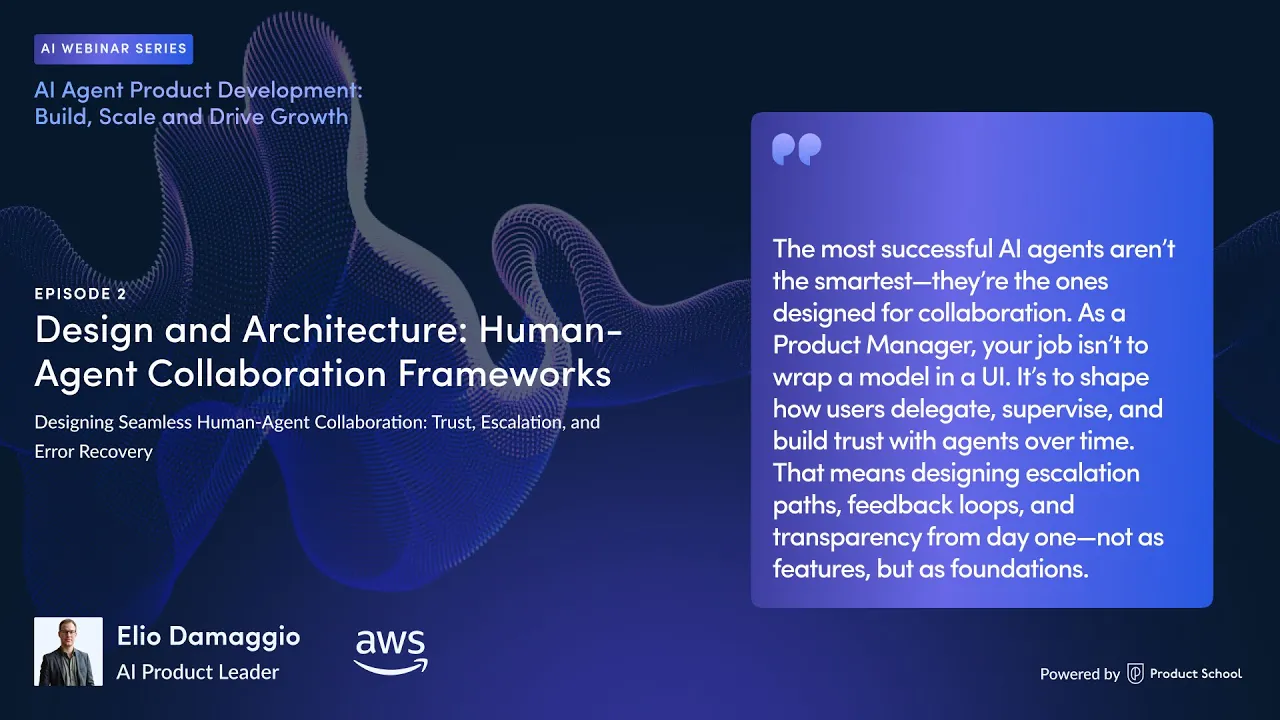
Often, how your agent handles errors and limitations is even more important than how it handles success. Users can forgive mistakes if they understand them, can recover from them, and trust that the system will learn.
— Ellio Damaggio, Head of Product at Amazon, said in the AI Series episode “Design and Architecture: Human-Agent Collaboration Frameworks (Episode 2)"
5. Invest in user experience
Design the experience around user intent, not around agents. Start from the question “What should the user be able to ask for in plain language?” and only then figure out how many agents you need behind the scenes to make that happen.
Meet people where they already work. If your teams live in Slack, Jira, or Salesforce, make the multi-agent system feel like a native part of those tools instead of a separate chatbot on the side. Keep responses short, clear, and actionable, with links or buttons that let users confirm, edit, or override what the agents propose.
Treat your first users as partners, not just consumers. Give them a simple way to give feedback on agent behavior, and use that feedback to refine both the product experience and the underlying workflows so the system becomes more trusted and useful over time.
6. Leverage composable tools and APIs
Most of the value in agentic systems comes from giving agents reliable access to data and actions. Expose the things your business already knows (customer history, product catalogs, policies, metrics) through clean APIs or retrieval endpoints so agents can reason with real context instead of hallucinating.
Use composable components for search, retrieval, vector storage, and tool calling so you can upgrade individual pieces without rewriting the whole stack. As you scale, prefer open protocols and standardized interfaces so new agents can be added with minimal friction rather than bespoke integrations every time.
7. Measure impact and iterate
Choose evaluation metrics at two levels: agent performance (accuracy, latency, confidence) and system performance (cycle time, resolution rates, user satisfaction, cost-to-serve). This makes it clear whether the architecture is actually improving business outcomes or just creating an interesting demo.
Instrument everything from day one so you can trace decisions, compare versions, and quickly roll back changes that degrade results. Treat agentic workflows like products, not features. Ship small, collect real-world data, and iterate until the system reliably moves your chosen metrics in the right direction.
Why Agentic Architecture Matters Today
Agentic architecture is a practical design approach that lets product teams turn large models into coordinated, goal-driven systems that actually move work forward. If you are building AI for real users and real processes, this is where the next wave of value will come from.
The product teams that learn how to design, govern, and evolve agentic systems will shape how enterprises automate knowledge work in the coming years. Those who don’t will be stuck stitching together brittle chatbots and demo-ware while the market moves on.
Level up on your AI knowledge
Based on insights from top Product Leaders from companies like Google, Grammarly, and Shopify, this guide ensures seamless AI adoption for sustainable growth.
Download Guide
Updated: March 4, 2026